
Cyclic Siloxane Testing
ACE Laboratories offers the testing solutions you need to qualify the presence of cyclic siloxanes—namely D4, D5, and D6—in your products, so you can remain compliant with siloxane restrictions in the European Union and around the world.
Cyclic Siloxane Testing Methods
ACE Laboratories has developed a methodology, based on the European regulation, for detecting and quantifying cyclic siloxanes in consumer products. We can detect both volatile cyclic methyl siloxanes (vCMS), such as D4, D5, and D6, and volatile linear methyl siloxanes (vLMS), such as L2, L3, L4, and L5, via sophisticated analytical methods.
Siloxane testing can also be performed according to ASTM F2466 (Standard Practice For Determining Silicone Volatiles In Silicone Rubber For Transportation Applications)
GC-FID vs. GC-MS for Cyclic Siloxane Testing
There are several different ways to approach cyclic siloxane testing.
The preferred analytical technique is Gas Chromatography—Flame Ionization Detector (GC-FID). GC-FID utilizes the FID as a quantitative detector. The retention times for D4, D5, and D6 are documented, making GC-FID a reliable method for detecting these molecules within a given compound.
However, there are many different molecules with retention times similar to D4, D5, and D6. If any of those molecules are also present in the compound, the result can be a false positive. If this occurs, another option is Gas Chromatography—Mass Spectrometry (GC-MS), a qualitative analytical technique. As molecules exit the analytical column of a GC-MS instrument and enter the detector, each molecule is fragmented in a specific, reproducible way, producing a “mass spectrum” that reports information on the constituents of the molecule. Analytes with the same retention time, which may have been indistinguishable to the GC-FID, produce different peaks and can be separately identified by the GC-MS instrument.
This qualitative certainty can be incredibly valuable in some contexts. GC-MS can detect interferences that cause values for analytes of interest to be greatly reduced or even eliminated.
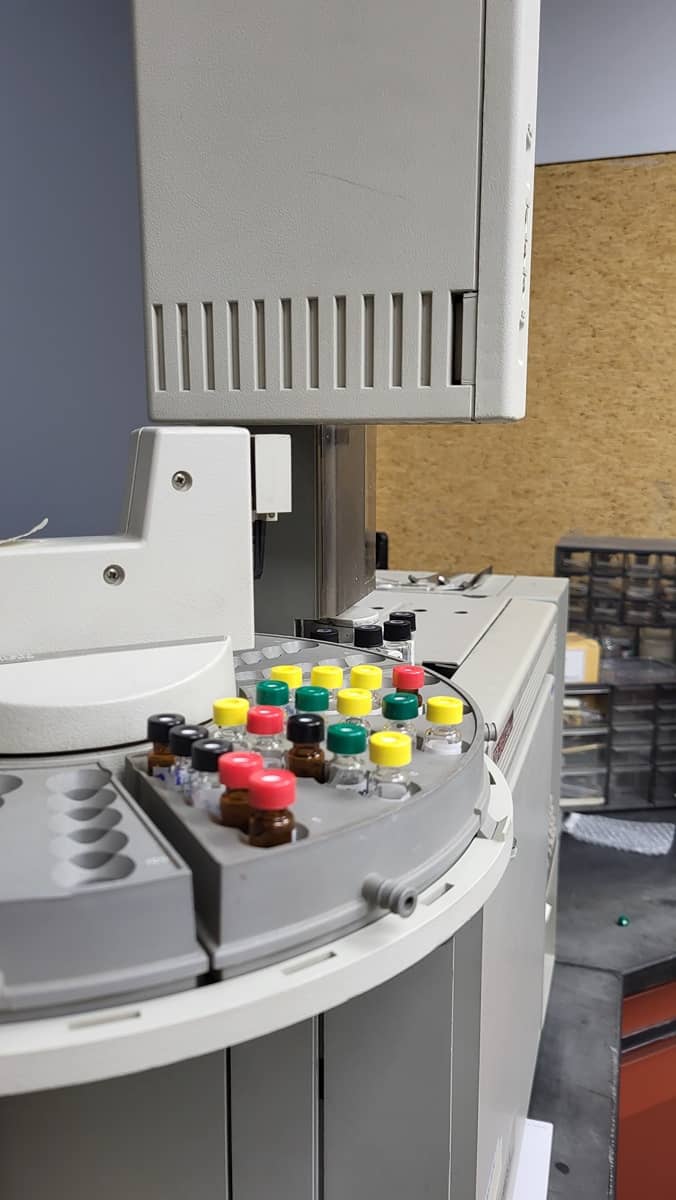
When should manufacturers utilize GC-MS versus GC-FID for siloxane testing and analysis at ACE Laboratories?
At ACE Laboratories, the decision to utilize Gas Chromatography-Mass Spectrometry (GC-MS) versus Gas Chromatography-Flame Ionization Detector (GC-FID) depends heavily on the complexity of the product matrix and the required level of analytical certainty. GC-FID is often considered a preferred foundational technique that functions as a highly sensitive quantitative detector. Because the retention times for specific volatile cyclic methyl siloxanes—such as D4, D5, and D6—are thoroughly documented, GC-FID is an exceptionally reliable method for routine detection within relatively straightforward chemical formulations. However, GC-FID can struggle when testing compounds with molecules similar to siloxanes.
When the risk of false positives is unacceptable or when testing complex matrices where chemical interferences are likely, ACE Laboratories relies on GC-MS. Unlike GC-FID, GC-MS acts as a highly sophisticated qualitative analytical technique.
To determine the best approach, the specific use cases for each method at ACE Laboratories include:
- Routine Quantification (GC-FID): Best utilized for relatively simple, known product matrices where the risk of co-eluting molecules sharing a retention time with D4, D5, or D6 is exceptionally low.
- Eliminating False Positives (GC-MS): Deployed when a sample contains multiple chemical analytes with identical retention times that are completely indistinguishable to a GC-FID instrument, allowing them to be separately identified via different mass spectrum peaks.
- Overcoming Chemical Interference (GC-MS): Highly necessary in complex consumer goods or industrial materials where background interferences might cause the actual values of targeted siloxane analytes to be significantly reduced or completely masked.
- Qualitative Certainty (GC-MS): Essential when absolute confirmation of molecular structure is required to pass stringent environmental regulations, verify a lack of toxicity, and maintain global supply chain compliance.
- Complex Compound Profiling (GC-MS): The optimal choice when a manufacturer requires simultaneous, highly accurate qualitative profiling of a broad range of both cyclic and linear siloxanes to prepare for emerging worldwide restrictions.
By deeply understanding the distinct advantages and inherent limitations of both GC-FID and GC-MS methodologies, ACE Laboratories ensures that every client receives the precise testing data necessary to confirm product safety without the risk of costly false positives.
How do the siloxane testing and analysis services at ACE Laboratories help ensure compliance with global regulations?
ACE Laboratories actively supports chemical regulatory compliance strategies with comprehensive siloxane testing that ensures your products meet all necessary regulations. While initial siloxane restrictions originated in the European Union, regulations are actively expanding into North America, making proactive compliance testing absolutely essential for both national and global market access.
ACE Laboratories performs specialized siloxane testing and analysis that focus on the following critical areas:
- European Union REACH Adherence: Validating that consumer products meet the strict 0.1% by weight concentration limits for restricted siloxanes under the EU’s REACH framework (Registration, Evaluation, Authorisation and Restriction of Chemicals).
- Emerging North American Restrictions: Helping manufacturers adapt to new state-level restrictions recently implemented in Maine while simultaneously preparing formulations for anticipated siloxane regulations expected to be enacted in California and other states.
- PBT and vPvB Verification: Delivering precise analytical data to confirm the absence of substances classified as Persistent, Bioaccumulative, and Toxic (PBT) or very persistent and very bioaccumulative (vPvB), particularly D4, D5, and D6.
- Environmental and Biological Safeguarding: Providing the chemical verification needed to protect marine life, aquatic ecosystems, and human reproductive, immune, and nervous systems from the long-lasting negative effects associated with restricted siloxanes.
- Proactive Linear Siloxane Monitoring: Anticipating future regulatory shifts by testing for linear siloxanes (L2 through L6) before formal restrictions are finalized, allowing brands to stay ahead of international compliance curves.
What specific compounds and products are included in the siloxane testing and analysis conducted by ACE Laboratories?
ACE Laboratories tests for volatile cyclic methyl siloxanes (vCMS) and volatile linear methyl siloxanes (vLMS) with our extensive siloxane testing capabilities.The specific siloxanes and product categories rigorously tested by ACE Laboratories include:
- Targeted Cyclic Siloxanes (vCMS): Our extensive testing capabilities detect D3, D4 (octamethylcyclotetrasiloxane), D5 (decamethylcyclopentasiloxane), D6 (dodecamethylcyclohexasiloxane), D9, and D12. These molecules are heavily monitored due to their classifications as Persistent, Bioaccumulative and Toxic (PBT).
- Targeted Linear Siloxanes (vLMS): We provide comprehensive analysis of linear variants including L2 (hexamethyldisiloxane), L3 (octamethyltrisiloxane), L4 (decamethyltetrasiloxane), L5 (dodecamethylpentasiloxane), and L6, which are increasingly being considered for regulatory action.
- Cosmetics and Personal Care: Our specialized extraction and detection methodologies are ideal for makeup products, lotions, deodorants, and hair conditioners, where compounds like D4 and D5 are often utilized as emollients and protective barriers.
- Nutraceuticals and Health Products: We conduct highly sensitive siloxane analysis for consumable items such as vitamins, ensuring they are entirely free of restricted cyclic and linear siloxane contamination.
- Industrial and Engineering Materials: We perform detailed testing of industrial silicone, silicone rubber compounds, and transportation components according to stringent standards like ASTM F2466 to accurately determine silicone volatiles.
By evaluating a diverse array of consumer and industrial products, ACE Laboratories delivers the precise qualitative and quantitative data necessary for companies to reformulate goods, ensure consumer safety, and proactively navigate evolving environmental restrictions.
Which specific industries and product types depend on ACE Laboratories for expert siloxane testing and analysis?
The primary product categories meticulously evaluated by ACE Laboratories include:
- Cosmetics and Personal Care Products: Comprehensive testing of everyday leave-on cosmetics, including makeup products, body lotions, deodorants, skincare formulations, and hair conditioners.
- Nutraceuticals and Dietary Supplements: Highly sensitive siloxane analysis for consumable health products, specifically testing vitamins to ensure the complete absence of restricted cyclic and linear siloxane contamination, thereby safeguarding human ingestion.
- Industrial Silicone and Engineering Materials: Detailed chemical evaluation of heavy-duty industrial silicone and silicone rubber compounds, ensuring these robust manufacturing materials adhere to all necessary safety thresholds and environmental compliance parameters.
- Transportation and Automotive Components: Rigorous testing of specialized silicone applications (per ASTM F2466) used throughout the transportation sector.
Cyclic Siloxane Testing from ACE Laboratories
Our testing facilities in northeast Ohio are equipped for a wide range of analytical techniques, as well as sample preparation methods, so we can accommodate virtually any product for testing and deliver accurate data every time. ACE is proud to offer some of the fastest turnaround times in the industry, so you can keep your projects on schedule.